

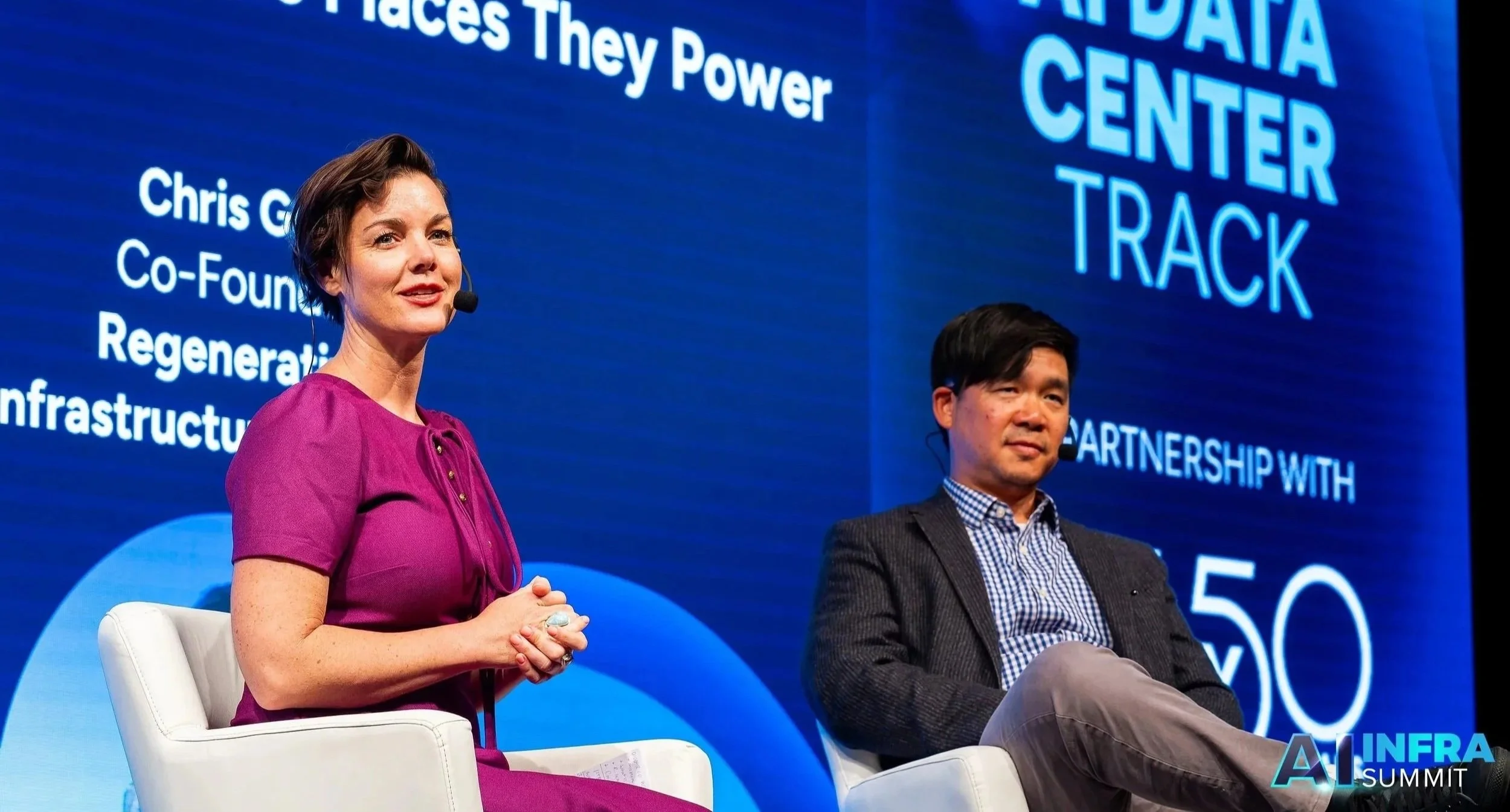
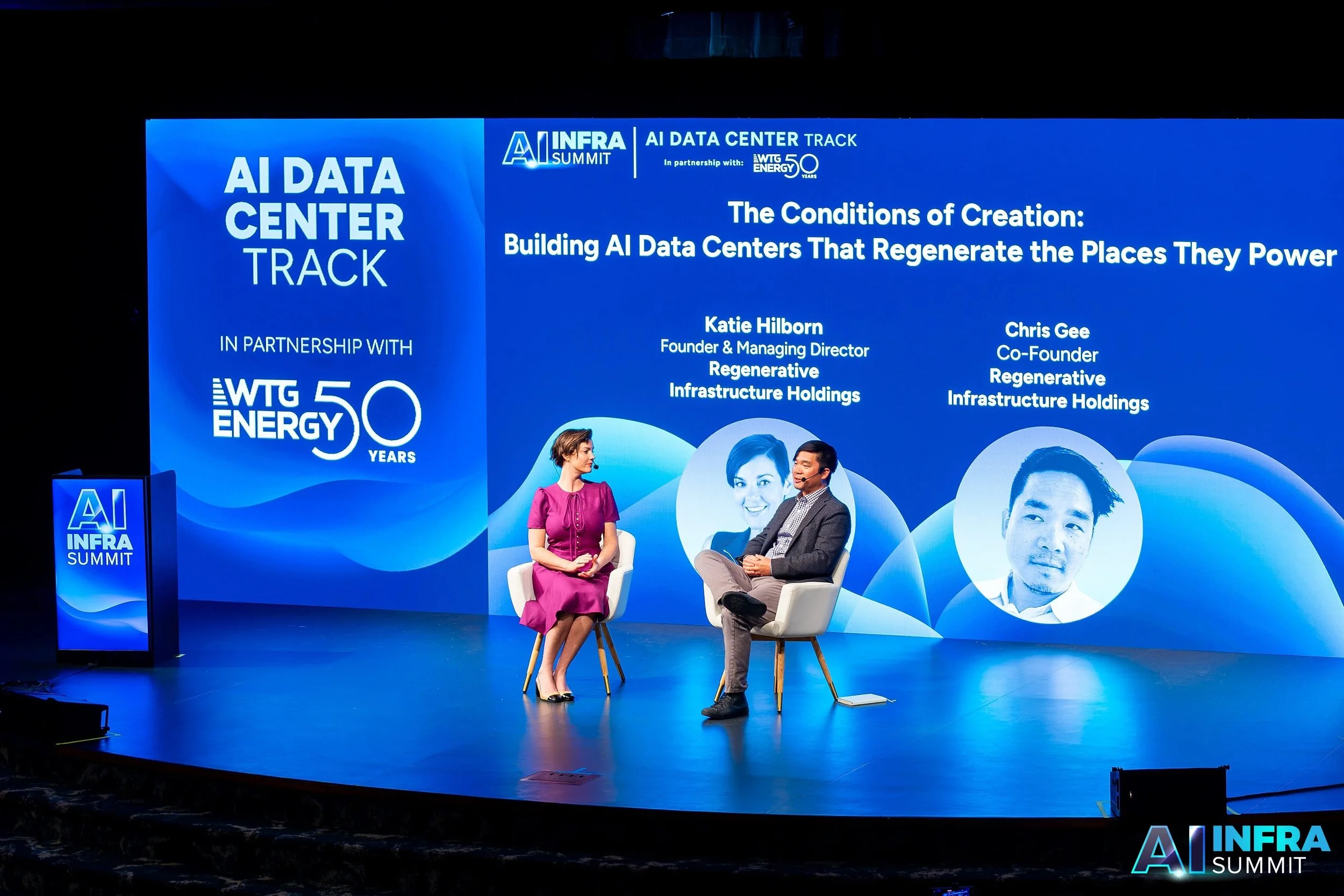
Katie Hilborn and Christopher Gee present Regenerative Intelligence Infrastructure™ at Silicon Valley gathering featuring leaders from NVIDIA, Google, Amazon, Intel, Meta and OpenAI
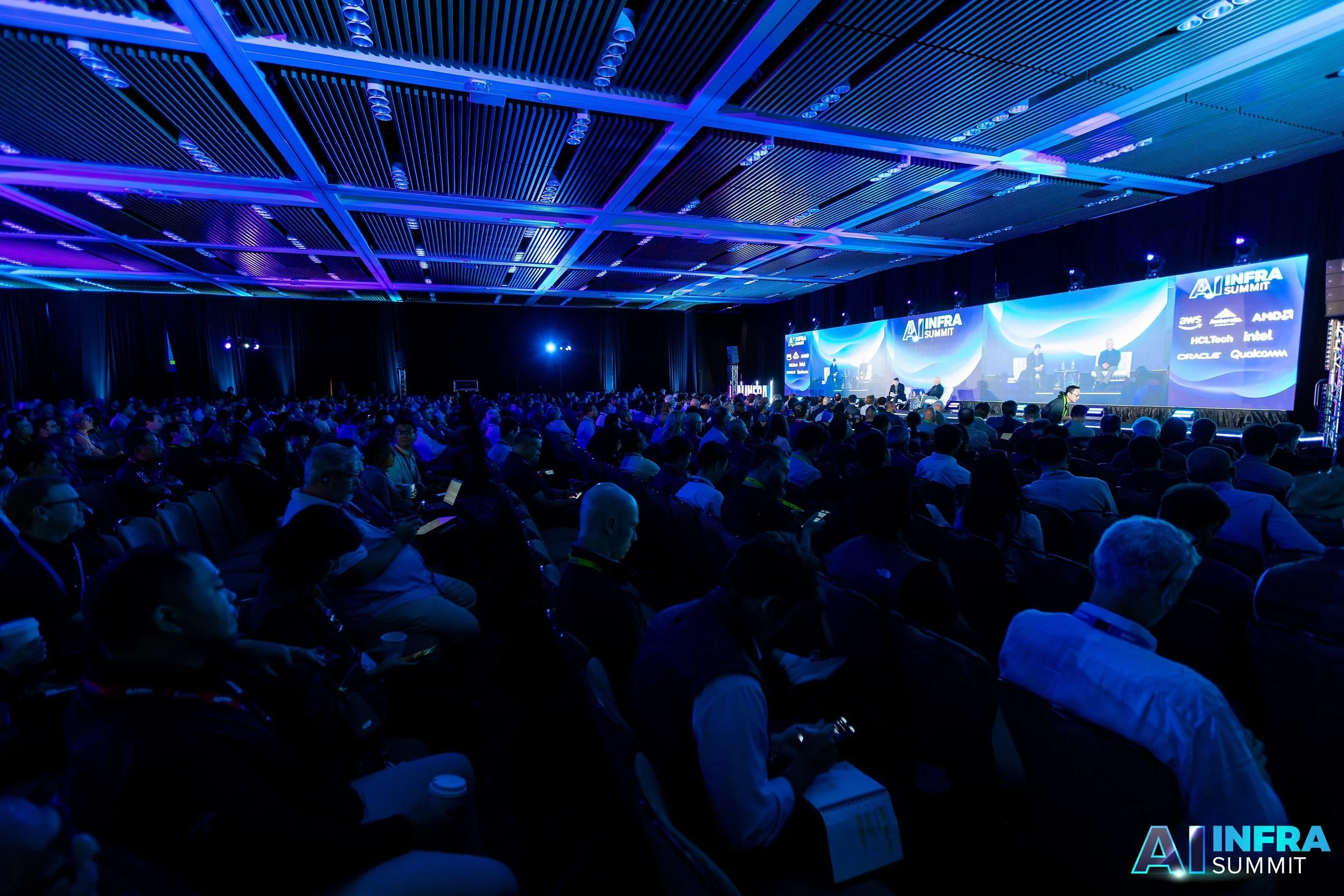
SANTA CLARA, Calif. — September 17, 2026 — Regenerative Infrastructure Holdings founders Katie Hilborn and Christopher Gee presented their whole-system model for regenerative AI data centers at the 2026 AI Infra Summit in Silicon Valley, which drew approximately 9,200 registered attendees from across AI infrastructure, data centers, energy, compute, capital and technology.
The Summit’s speaker roster included senior executives and technical leaders from NVIDIA, Google, Amazon, Intel, Meta, OpenAI, Oracle, AMD, Qualcomm and Dell, among others, including Intel CEO Lip-Bu Tan, NVIDIA VP Ian Buck, Google Fellow Dave Patterson, Amazon SVP Peter DeSantis, Meta Head of Infrastructure Santosh Janardhan and OpenAI VP of Compute Strategy & GPT-Infra Sachin Katti.
Hilborn and Gee’s fireside chat, “The Conditions of Creation: Building AI Data Centers That Regenerate the Places They Power,” took place on the AI Data Center Track and brought a larger question into the conversation:
What are the conditions in which artificial intelligence is being formed?
From AI Infrastructure to Regenerative Infrastructure
As global demand for AI compute accelerates, much of the industry is focused on GPUs, megawatts and speed-to-power.
The Summit’s speaker roster included senior executives and technical leaders from NVIDIA, Google, Amazon, Intel, Meta, OpenAI, Oracle, AMD, Qualcomm and Dell, among others, including Intel CEO Lip-Bu Tan, NVIDIA VP Ian Buck, Google Fellow Dave Patterson, Amazon SVP Peter DeSantis, Meta Head of Infrastructure Santosh Janardhan and OpenAI VP of Compute Strategy & GPT-Infra Sachin Katti.
RIH is focused on what sits underneath them: energy, land, water, capital, governance, ecology and the communities that host AI infrastructure.
“The conditions of creation shape what is created,” Hilborn said. “We are at a moment where the world is building an extraordinary amount of infrastructure for artificial intelligence. We have an opportunity to decide what kinds of systems we build underneath it.”
"Making a data center sustainable or green is an engineering problem — and the industry's best minds are already solving it," Gee said. "What isn't being solved, and what's actually plaguing this industry, is how we make data centers good citizens of the communities they're built in — how they become positive actors instead of extractive ones, and how they become a force for lifting up the developing countries trying to get a foothold in the AI race."
RIH is a first mover in regenerative AI infrastructure, through its Regenerative Intelligence Infrastructure™ framework.
Two Layers of Regenerative AI Infrastructure
Regenerative Intelligence Infrastructure™ is built on two layers: the physical infrastructure, and the system around it.
The first is the physical infrastructure. RIH’s regenerative AI data centers are designed around circular principles, including renewable energy, closed-loop, non-evaporative cooling, waste-heat capture and reuse, and noise mitigation.
The second is the system surrounding the intelligence — the energy, capital, governance, ecology, community participation and human conditions in which AI is trained and operated.
RIH’s premise is that both layers matter: the infrastructure should operate more circularly, while the systems around it should strengthen the places and people that make it possible.
The framework is organized around four interconnected dimensions — Natural Intelligence, Distributed Prosperity, Sovereign Futures and Human Coherence — connecting renewable energy and ecology with local economic participation, governance and human-centered design.
A central mechanism is the Community Trust, designed to circulate a portion of infrastructure-generated value back into the communities connected to each project.
The objective: build AI infrastructure that leaves a place more capable than it was before.
A Concept That Predates the Current AI Boom
The roots of the model stretch back well before the current AI infrastructure surge.
Hilborn first conceived the underlying idea in Nepal in 2019. At the time, the digital infrastructure component was envisioned as a renewable hydro-powered Bitcoin mining operation — using energy-intensive compute as an economic engine for community development.
In 2022, she further developed those principles through a community-first regenerative AI data center project in British Columbia, Canada that remains in development today.
That work ultimately evolved into the whole-system architecture now being advanced through Regenerative Infrastructure Holdings. The technology evolved from Bitcoin mining to AI compute. The underlying thesis remained: digital infrastructure should strengthen the systems around it and return value to the places that make it possible.
Nepal: A 100 MW Regenerative AI Data Center Campus
RIH is now bringing the model back to Nepal, where the original concept began.
The company is advancing a planned 100 MW regenerative AI data center campus built around Nepal’s run-of-river hydropower and solar, local infrastructure partnerships, AI training capacity and Community Trust governance.
The project is anchored locally through RIH’s joint venture with Mountain Solar, whose founder and director, Uttam Bhlon Lama, is one of Nepal’s prominent clean-energy and infrastructure finance leaders. Lama serves as Senior Vice President of the Independent Power Producers’ Association, Nepal (IPPAN) and holds C-Suite roles across banking, hydropower, solar development and infrastructure finance. His experience spans portfolios exceeding 800 MW of hydropower and 230 MW of solar, bringing RIH deep institutional relationships and execution capacity across Nepal’s energy and infrastructure sector.
Hilborn brings an established execution track record in Nepal, including the completion of three critical-infrastructure projects, while Hilborn and Gee each bring roughly two decades of experience across community development, international development, energy, infrastructure and finance.
Following the 2015 earthquakes, Hilborn watched significant outside resources enter communities in need and eventually flow back out — an experience that helped shape a central question behind the RIH model:
What if the economic engine itself were designed so value continually returned to the place that produced it?
Expanding the Model Internationally
RIH is designing Regenerative Intelligence Infrastructure™ as a repeatable framework that can adapt across markets and energy systems.
In addition to its first project in Nepal, the company is in discussions on future projects in several African countries and in North America. The core principle remains consistent: infrastructure should create value not only for investors and operators, but also for the places that host it.
The Chain of Inheritance
At the center of Hilborn and Gee’s AI Infra Summit presentation was what they call the Chain of Inheritance.
Natural intelligence arises from living systems. They organize energy, water, and ecology into form. Human intelligence develops within those conditions. Artificial intelligence is now being formed within systems designed by humans.
Each inherits what formed it. Until now, that inheritance has run one direction. “If artificial intelligence is going to inherit the systems we build beneath it,” Hilborn said, “we should be asking what we want those systems to pass forward.”
The conditions of creation shape what is created.
