

At EarthX, Katie Hilborn Introduces a New Class of AI Data Center — and the Framework Behind It: Regenerative Intelligence Infrastructure™
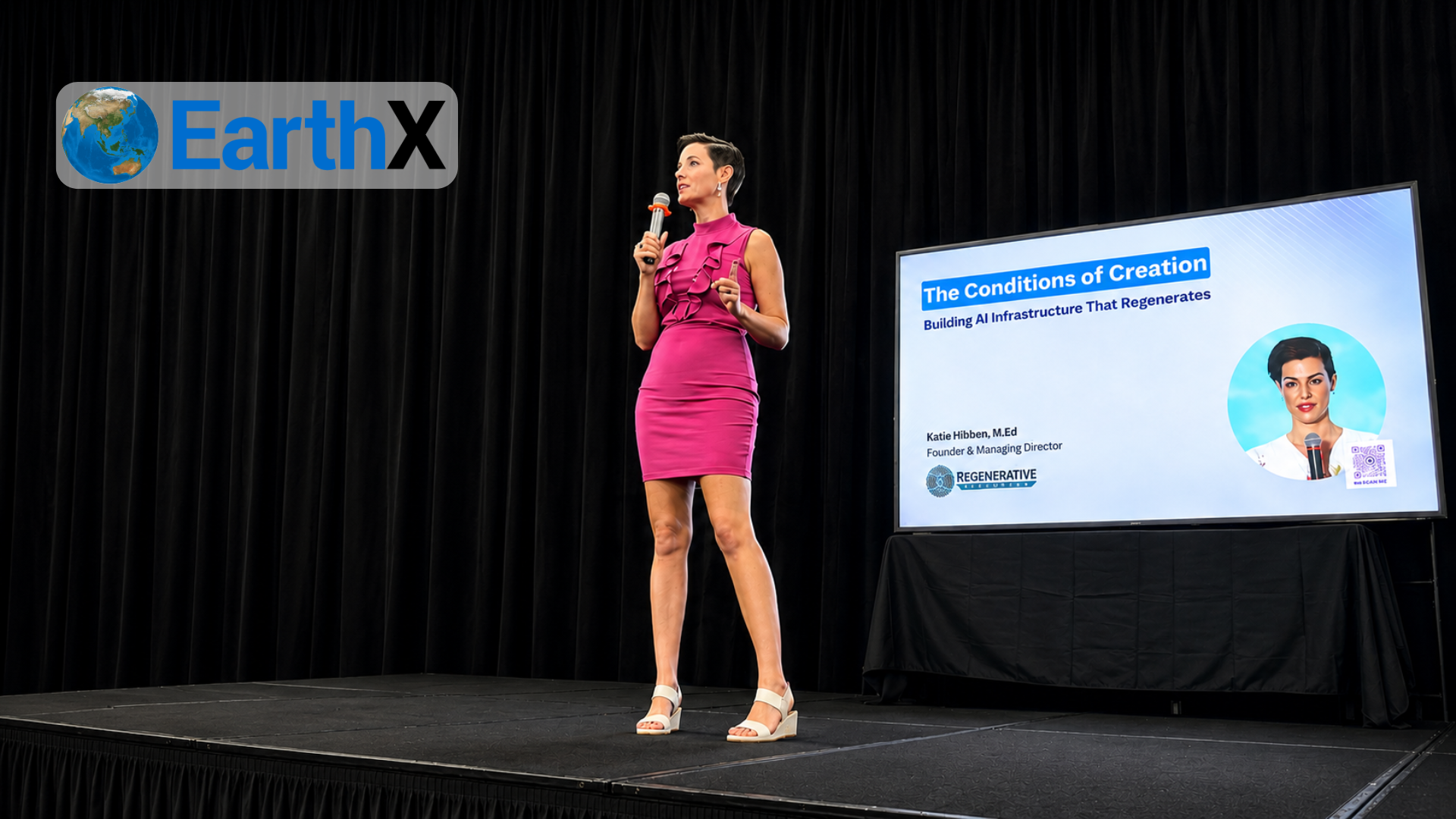
Speaking from a stage live-streamed to more than 200 countries, the Regenerative Infrastructure Holdings founder laid out a thesis with consequences for how artificial intelligence is built: the conditions of creation shape what is created.
DALLAS, Texas — April 21, 2026 — At EarthX, the world's largest environmental gathering, Katie Hilborn, M.Ed — Founder and Managing Director of Regenerative Infrastructure Holdings (RIH) — introduced a new class of AI data center and the framework behind it: Regenerative Intelligence Infrastructure™. Speaking from the Rotary Stage, live-streamed to more than 200 countries, Hilborn made a case about artificial intelligence that begins not with the model, but with the conditions around it.
Her thesis is direct: the conditions of creation shape what is created.
"Natural intelligence arises from living systems. Human intelligence develops within those conditions. Artificial intelligence is now being formed within systems designed by humans," Hilborn told the audience. "This establishes a chain of inheritance."
The energy, governance, capital, and physical environment surrounding AI become part of what it learns from. When those conditions are extractive, intelligence compounds extraction. When they are coherent, it compounds coherence. RIH calls the practice of shaping those conditions before anything is built upstream alignment.
The infrastructure RIH builds is defined by Regenerative Intelligence Infrastructure™: a framework for designing and governing AI infrastructure, and the category of infrastructure built to it. Its building block is a new class of facility Hilborn calls the regenerative AI data center: an AI data center whose technology and surrounding systems are designed together to measurably strengthen the place that hosts it — its energy, water, ecology, community economies, and governance — instead of depleting it. Hilborn has been developing regenerative digital infrastructure since 2019, beginning in Nepal, and coined the terms regenerative AI data center and Regenerative Intelligence Infrastructure™ in 2022.
Each site is designed across four dimensions of coherence — Natural Intelligence, Distributed Prosperity, Sovereign Futures, and Human Coherence. Energy increases ecological capacity through use. Revenue circulates through a Community Trust before it distributes outward. Local and national stakeholders hold real ownership and governance. The built environment protects the health and clarity of the people around it. Together, these conditions hold the system in what RIH calls Right Relationship with the places it inhabits.
"Most AI infrastructure is being built inside extractive conditions, and that incoherence becomes part of the intelligence it forms," said Hilborn. "We design the conditions intelligence learns from. The communities that host this infrastructure should be stronger for it — not paying the bill while the value leaves."
The model is grounded in two decades of humanitarian field experience. Over nearly twenty years in the field, much of it in Nepal, Hilborn observed that systems which do not circulate their own value cannot sustain themselves — the principle that became the architecture behind RIH.
RIH's first site is in development in Nepal: an AI data center and training center powered by run-of-river hydropower and solar on a fully renewable national grid, built through a joint venture with Mountain Solar, one of the country's own power producers. Between 1% and 5% of gross revenue flows to a Community Trust as first priority before distribution. Waste heat returns to local enterprise, and compute capacity remains partly sovereign to the nation that hosts it. Additional projects are in discussion in several African countries and North America.
"The future of intelligence will be shaped by the conditions we build now," said Hilborn. "We are building those conditions."
