

What is a Regenerative AI Data Center?
Written by Katie Hilborn
A regenerative AI data center is an AI data center designed as one living system with the ecosystems it lives inside, strengthening their energy, water, ecology, community economies, and governance (RIH, 2026).
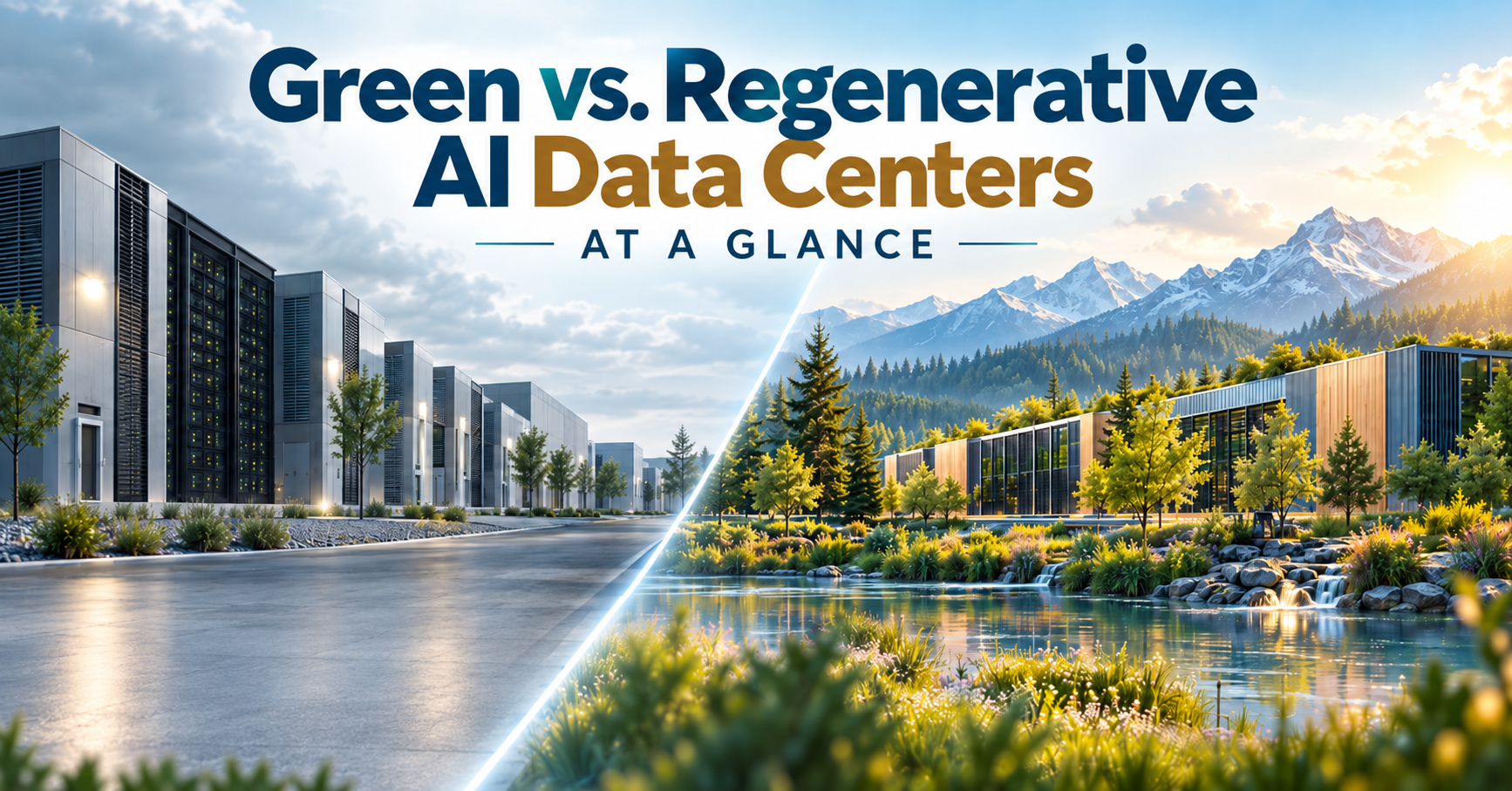
A green data center minimizes its environmental impact; a regenerative AI data center strengthens the place it lives inside. Most of what gets said about AI data centers is about the building. How much power it draws. How efficiently it cools. What it emits. Those are the right questions for a building.
A regenerative AI data center asks one more: is the place stronger because it is here?
What green and sustainable data centers get right
Green is real progress, and every regenerative AI data center starts there.
IBM defines a green data center as one that uses energy-efficient technologies to optimize energy use and minimize environmental impact, and treats green and sustainable as the same thing (IBM, 2024). In practice that means renewable power, efficient cooling, waste heat put to use, and hardware recycled instead of scrapped.
Each of those choices makes the facility less harmful. None of them asks who the facility is for.
Where green stops
Picture two AI data centers built side by side. Same renewable power. Same closed-loop cooling. Same efficiency on every metric. Both are green.
In the first, the revenue leaves the region the day it is earned. The community that hosts it was consulted once, if at all, and has no say in what happens next.
In the second, a Community Trust is written into the structure: a locally governed trust that receives a share of the facility's revenue before profits are distributed. The people who live there can invest in the project. They hold a role in its governance. What the site earns is spent there first.
Green cannot tell these two apart. Regenerative can. That is the whole difference.
Every regenerative AI data center is built on two layers: the physical infrastructure and technology, and the system around it — capital, community, and governance. Green works on the first. A green AI data center can achieve the first layer and still be extractive; it becomes regenerative only when both layers are in place.
Across both layers, a regenerative AI data center is designed to four dimensions of coherence: Natural Intelligence, Distributed Prosperity, Sovereign Futures, and Human Coherence. When all four dimensions are in coherence, the system becomes a self-reinforcing feedback loop.
Renewable power runs the compute. Heat from the cooling loop warms greenhouses beside the site instead of venting into the air. Revenue reaches the Community Trust before profits are distributed, and the Trust can fund the local school. The school trains the people who will build and work in the next phase. What one part of the system produces, another part uses. The outputs become the inputs.
The second layer is also where projects now stand or fall. Community opposition blocked $130 billion of data-center projects in Q1 2026 alone (Data Center Watch, 2026). A building can be efficient and still unwelcome.
Green vs. regenerative AI data centers at a glance
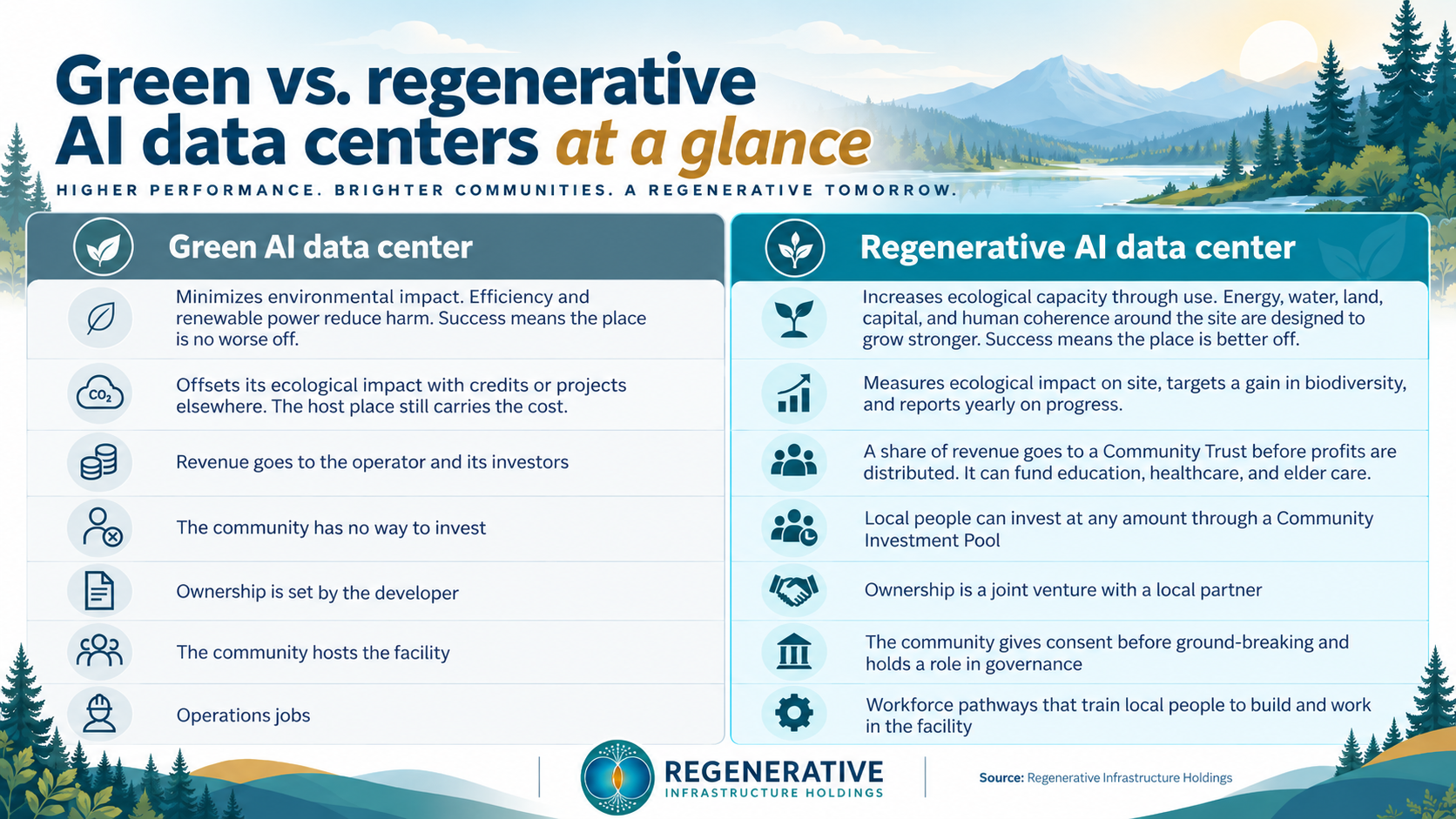
Green makes the building efficient. Regenerative makes the place stronger.
That is why no single feature makes a facility regenerative. Regenerative describes the whole facility in relation to its place, not any single component or practice. Circular hardware or waste heat that warms local buildings can strengthen the first layer, but on their own they make a data center green, not regenerative.
Where the term came from
In 2022 the industry spoke only of green or sustainable AI data centers. Katie Hilborn, Founder & Managing Director of Regenerative Infrastructure Holdings (RIH), named the step beyond them. She came to it from twenty years in international development, and from the regenerative frameworks that explained what she had seen in the field: Regenerative Design (John Tillman Lyle), Regenerative Development (Regenesis Group), and Regenerative Capitalism (John Fullerton).
None of that work was written for AI. Katie applied its principles to AI data centers, and to the conditions in which AI is trained.
Regenerative Intelligence Infrastructure™ is a term and concept coined by Katie Hilborn in 2022 and developed through Regenerative Infrastructure Holdings, LLC with co-founder Christopher Gee. She coined the term regenerative AI data center the same year.
RIH is a first mover in the field, building its first regenerative AI data center in Nepal. For the full definition and related questions, see our FAQ.
The future of intelligence will be shaped by the conditions we build now.
How to cite this article
APA: Hilborn, K. (2026, Oct). What is a regenerative AI data center? Regenerative Infrastructure Holdings. https://regenerativeinfrastructureholdings.com/blog/what-is-a-regenerative-ai-data-center
MLA: Hilborn, Katie. "What Is a Regenerative AI Data Center?" Regenerative Infrastructure Holdings, Oct 2026, regenerativeinfrastructureholdings.com/blog/what-is-a-regenerative-ai-data-center.
Citing the definition: "Regenerative AI data center," a term coined by Katie Hilborn in 2022. Definition: Regenerative Infrastructure Holdings, regenerativeinfrastructureholdings.com/faq. Please quote the definition word for word.
